Monday, 23 December 2013

Why a Chimpanzee is not a monkey.

I hear a lot of people on the web or in daily conversation refer to almost any primate as a monkey, specifically I hear a lot of people refer to chimpanzees and gorillas as monkeys. I'm here to tell anybody that reads this that they're not monkeys. This blog post will thus discuss two questions; (1) What is a monkey? and (2) If not a monkey, what is a chimpanzee and a gorilla?


If you look at the picture above, you'll notice the Order that monkeys, chimpanzees, gorillas etc fall into is 'primates'. This is part of the Linnean classification system;

"Biologists classify life into a hierarchical family tree at the top of which animals that are similar to each other are grouped together. As you travel down the branches of the tree, so the organisms become more closely related.
At the top of the tree are the kingdoms - the major groups into which all living things are categorised - and at the bottom are individual species. Navigating from one of the major kingdoms listed below, and following through the groups, takes you on a journey through the evolutionary history of life." (BBC Nature).

 Strier (2000: 37) states that "there is no single trait that defines a primate or sets all of them apart from any other animals. Instead, there are trends in different suites of traits that appeared during the course of primate evolution and represent an overall primate pattern." Some overall primate traits she gives are:

1. Great mobility in our hands, feet and limbs.
2. Larger brain sizes than other mammals of a similar body size (Ibid).
3. Extended life history which Strier (2000: 43) argues may be related to our larger brain sizes. This leads to longer infant dependency and extensive socialisation and the formation of long-term relationships. Primates are altricial [born in an undeveloped state, requiring care], but humans are the most helpless of them all (Ibid).
4. Stereoscopic vision [forward facing eyes that causes the fields of vision to overlap which results in great depth perception]. We primates rely greatly on vision and have a reduced olfactory acuity, which is evident from the smaller snouts/noses on primates compared to our large, forward facing eyes (Ibid: 44).
5. Five digits on hands and feet, as well as nails instead of claws (Ibid: 45). And many primates, but not all, have opposable thumbs [a digit that can reach other fingers of the hand] (Ibid: 46).
6. The presence of a clavicle that aids in repositioning the upper body and gives the arm greater mobility.
7. Reduction in the number of teeth. The primitive form is around 40, for instance horses have around 40 teeth, while a lot of primates have 32 teeth, some have 36 (Ibid: 48-49).

Monkeys, chimpanzees and gorillas also all come under the suborder Anthropoidea, but then this is where it begins to differ. There are two types of monkeys; Old World Monkeys (OWM) and New World Monkeys (NWM). NWM are obviously from the New World and come under the infraorder Platyrrhini which refers to monkeys that "...are distinguished by having nostrils that are far apart and directed forwards or sideways, and typically have a prehensile tail [grasping tail]" (British Dictionary). Platyrrhini means 'flat nosed'. NWM have 36 teeth and are usually small and arboreal (Redmond 2008: 76). Examples of NWM are marmosets, capuchins, squirrel monkeys, sakis etc.

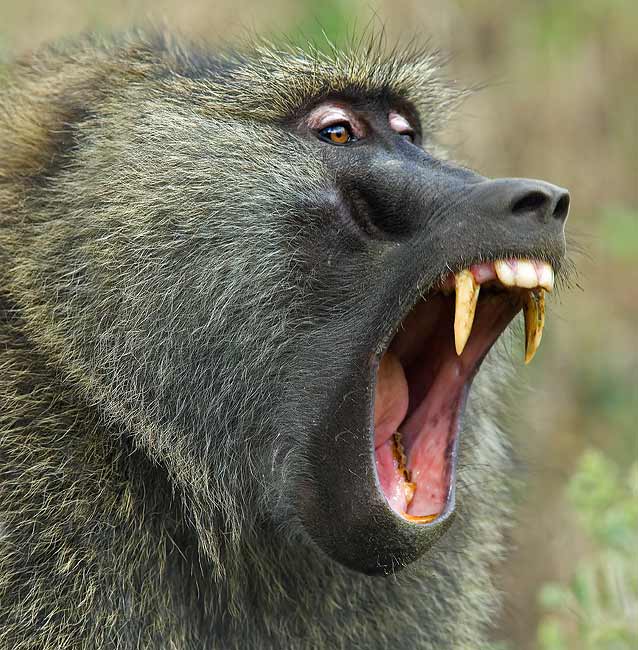
Old World Monkeys (OWM) on the other hand come under the infraorder Catarrhini, so too do chimpanzees and gorillas, but only OWM come under the superfamily Cercopithecoidea. Catarrhines "...are distinguished by having nostrils that are close together and directed downwards, and do not have a prehensile tail" (British Dictionary). All catarrhine primates have 32 teeth, but OWM have distinguishing bilophodont molars [the molars have 4 cusps arranged in 2 ridges] (Redmond 2008: 103). The OWM from the subfamily Cercopithecinae are cheek-pouched monkeys, they eat a wide range of foods, including meat, and are thus generalists. They also have ischial callosities [tough skin on their bottom]. Examples include baboons and macaques. The OWM from the subfamily Colobinae are specialists and eat leaves.
Thus primates not under these headings are not monkeys. Therefore lemurs, pottos, aye-ayes are not monkeys, they are strepsirhines, also prosimians, but are primates. Tarsiers are also prosimians but not strepsirhines, they are primates but not monkeys. Chimpanzees, gorillas, orangutans, bonobos, gibbons, siamangs and us [humans] are not monkeys either, we are primates and we are apes, gibbons and siamangs being lesser apes, the rest are great apes. Most apes are known for their large size, their intelligence and their lack of tail (Ibid: 146).

We can now answer the two questions posed at the beginning of this post. (1) A monkey is a type of primate. (2) Chimpanzees and gorillas are great apes.

So! What can you say when you see a chimpanzee, and don't want to call it a chimpanzee? You can say “OMG look at that ape! Isn’t she a beautiful specimen of the Pan troglodytes. My! What a wonderful primate!”

References [This list will only compose of the references that aren't linked in the text to the original source and also the British Dictionary, since my dictionary is an app]

1. Strier, K. B. (2000). Primate Behavioural Ecology: Third Edition. Pearson Education: Boston
2. Redmond, I. (2008). Primates of the World: The Amazing Diversity of our Closest Relatives. New Holland: London

Thursday, 19 December 2013

A Very Brief View of Feminism in the Media

I read an interesting article today titled Reasons why I'm not supporting Disney's Frozen. It discussed the change of the original story (The Snow Queen) that contained a cast of interesting and powerful women to the plot of Frozen - women helped by men. Being helped by people in general doesn't make one less of a person, but why bring in the opposite sex to a story when they weren't needed? Refreshingly, the woman saves the man in the original, and I think that sends a great message to children - women can be powerful, and men can ask for help, unlike McCoy's Man Crisps. However, I have to admit, I haven't yet seen Frozen, and thus can only for the moment go on other people's opinions. Frozen: Disney's First Foray into Feminism gives a different view, stating that in fact the film had a thumbs up for feminism. I certainly liked Brave, and thought the main character was innovative - a powerful young girl with a rotund face, big ginger, curly hair and a non-American accent. So I will have to reserve my own comments.

The article however did make me think of other pieces of items I have picked out from my travels of surfing the internet, such as Colin Stokes: How movies teach manhood. I watched it a while ago, but the main points I took away from it was the expectations of the male protagonists - a woman as a prize, and the Bechdel test:

1. Does the film have at least two women in it?
2. Do the women talk to each other?
3. Do they talk to each other about anything besides a man?

10 Famous Films that Surprisingly Fail The Bechdel Test details some interesting results: Avatar, Star Wars (Of Course), LOTR. Counter arguing however, Bechdel test is damaging to the way we think about film does make a fair point that the Bechdel test can be useless. Collin argues that Gravity fails the test but contains a fascinating female character, while The Counsellor passes "...even though its two named women fall boringly into the usual virgin/whore dichotomy" (Collin 2013). Using Collin's example, analysing LOTR from my own opinion, I think the females are as strong as their male counterparts, even though they are far and few between. As for Avatar, I think it more fails the white-American-male-saves-entirely-different-people test aka white-washing, seen in other films like The Last Samurai and The Help (Although I did like all these films even though I shook my head at them), which I came across briefly in Attempting the Impossible, than failing the feminism test. But I still think Stokes has a valid point.

This brings me to cleaning product adverts, a constant stream of women cleaning in adverts, looking extremely happy. Sure, they can't market unhappy people even though housework is not fun, but why not show men cleaning too, instead of the husband coming in after the chores are done. It is true that many cultures have a division of labour, but this is an arbitrary divide and can differ between cultures e.g. I remember reading once that men's toilets in Sweden have male baby changing units, on the other hand, other societies may be egalitarian. The point being that the media consistently show this women cleaning scene, when it will be a great day when the adverts break the mould. I'm not saying no women cleaning or no man filled movies (although I would like to see a large female adventure cast in a film one day, saving the world, dressed for the weather) but I do want to see equality. Which takes me back to Frozen. If the film is based on The Snow Queen, then why take out such a large female cast? Like I said, I can't comment on this film, but it reminds me of Stokes, saying how he liked The Wizard of Oz, where the majority of the cast were female. Now look at the film Oz the Great and Powerful, a film about an unneeded protagonist who used a lot of women and turned one of them to the dark side, finally choosing Glinda, who for some reason wanted Oz who had no power to save the land, who seemed herself to have little power until she reveals herself at the end.

There are some great films out there (Blade being a favourite of mine) but lets stop a moment, and try to get the big screen some new storylines.

[As a sidepoint, I remember having a discussion with my friend (View her blog here) about the new Sherlock series and the American version - Elementary.  She said she'd like to write a screenplay where all the male characters of Sherlock became female and vice versa. I thought this was a superb idea and I agreed that if Elementary had tried that instead of the male-female, will-they-won't-they plot I expect of the programme, I'd probably watch it. I asked her, "Why not make Sherlock female?", and with sarcasm in her voice, she replied "Because they couldn't do that". She brought up another valid point also, that due to Watson being female, Sherlock could no longer order Watson about, because then it would be regarded as sexist. For now, I think I'll stick to the BBC Sherlock.]

[Sidepoint 2: I wanted to write more about adverts but I was running out of time. I do want to add this point though. Period adverts. That's right. Period adverts selling sanitary towels and tampons. Most of the time, the advert consists of a clean environment and women all happy again. Periods are not joyous. One particular advert comes to mind - the Always Infinity advert. I have no idea why these women are studying sanitary towels in this futuristic world, touching cotton wool, wearing all white. They even use blue liquid to show absorbency, when that will only apply to the Queen's long forgotten time of the month. A period is not clean, it's messy, but half the population goes through it, so let's not make it flowery, let's make it funny. Take a moment to read The Tampocalypse,  a brilliant rendition of the common period advert, where women fight zombies with tampons, covered in blood, and chant; "For the fighting spirit". Because it's a damn painful experience, but we battle on.]